
Baldwin County Criminal Court Cases
Baldwin County divides criminal work by charge level. Superior Court hears felonies. State Court handles misdemeanors and traffic cases, and the Clerk of Superior Court maintains the records of both courts at 121 North Wilkinson Street in Milledgeville. The same clerk also handles Juvenile Court material, though juvenile access is restricted. Milledgeville Municipal Court, at 125 Floyd L. Griffin Jr. Street, hears city ordinances, traffic matters, and authorized misdemeanors.
A court file is not the same item as an arrest report or booking entry. It records the prosecution after a complaint, citation, accusation, or indictment reaches court. Pleadings, hearing entries, rulings, pleas, and the disposition show how the allegation changed. The broader Baldwin County arrest lookup explains the records created before filing; the criminal court case supplies the official judicial outcome.
The Baldwin clerk services page identifies the courthouse counter and its court-record work.
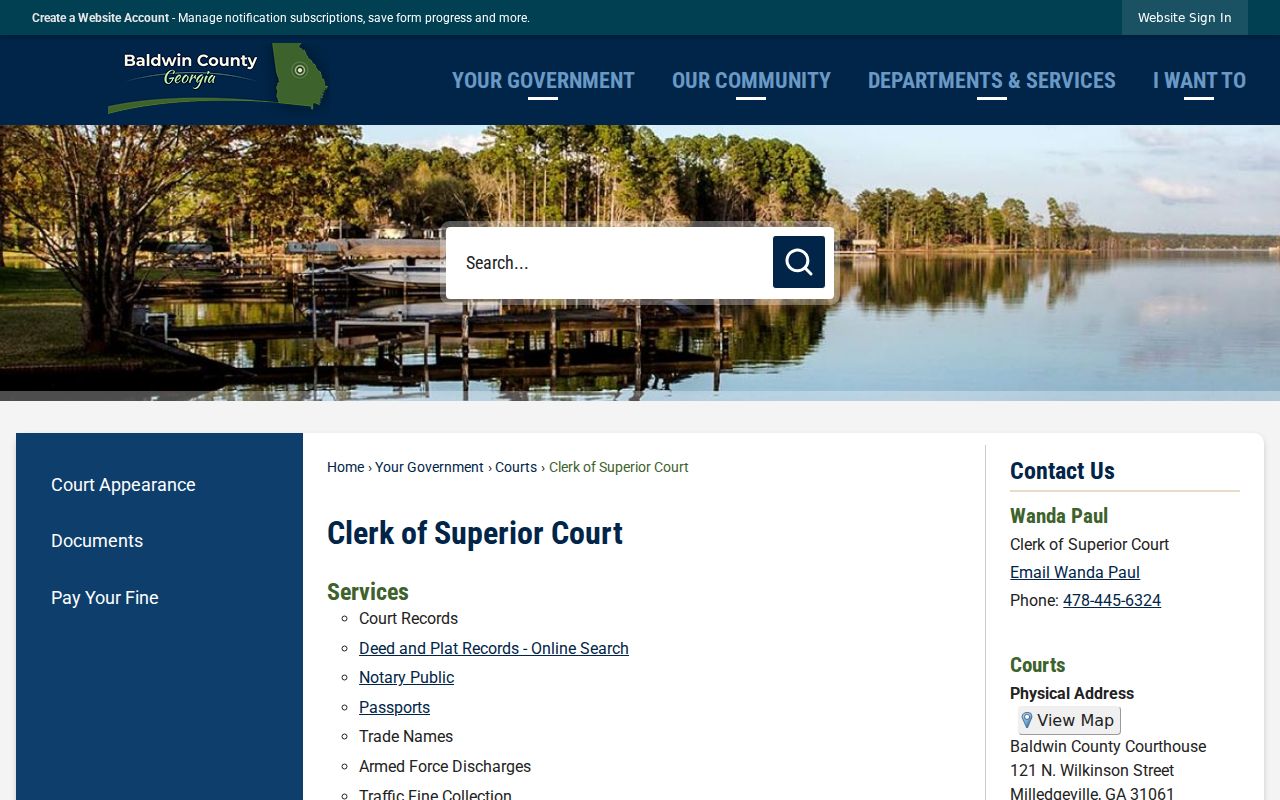
That source is the practical starting point when a web docket does not answer a Baldwin County court-record question.
Three Baldwin Court Record Paths
Choosing the right custodian prevents a fruitless name search. A felony accusation or indictment belongs with Superior Court. A county misdemeanor or traffic prosecution belongs with State Court. A city citation may remain with Milledgeville Municipal Court. Although the county clerk serves several courts from one courthouse, a caller should still name the suspected court and charge type.
Superior and State Court Clerk
121 North Wilkinson Street
Milledgeville, GA 31061
478-445-6324
State Court Criminal Deputy
P.O. Drawer 987
Milledgeville, GA 31059
478-445-4007
Municipal Court Clerk
125 Floyd L. Griffin Jr. Street
Milledgeville, GA 31061
478-414-4077
Note: Call before travel because official research did not locate dependable public-counter hours or current courthouse entry details.
Searching Baldwin County Case Records
Start with the fullest identifiers available: the name used at filing, an approximate year, the court, and a citation or case number. The clerk links a Baldwin civil and criminal docket, but that site could not be reached during inspection. The Georgia Courts E-Access directory separately routes Baldwin Superior and State Court users to PeachCourt, which requires an account. Neither route should be treated as complete for paper archives, sealed files, or confidential cases.
- Identify whether the matter is a felony, county misdemeanor or traffic case, or Milledgeville city case.
- Try the clerk-linked local docket, while recognizing that availability may change.
- Use Georgia Courts E-Access to reach the account-based PeachCourt route for Baldwin Superior and State Courts.
- Call the Baldwin County clerk at 478-445-6324 or visit the courthouse counter with the name, year, and number.
- Ask for the exact product needed: docket, order, disposition, plain copy, complete file, or certified copy.
| Search detail | Why it helps |
|---|---|
| Full case name | Separates people with similar names. |
| Case or citation number | Points to a single file or payment record. |
| Approximate year | Helps the clerk locate older or paper material. |
| Court and charge level | Distinguishes Superior, State, and Municipal custody. |
| Requested document | Clarifies whether the need is a docket, order, or certified disposition. |
When Baldwin's Docket Is Unavailable
An unavailable page does not mean Baldwin County has no court record. It means the online route cannot be relied on at that moment. The clerk remains the custodian, and PeachCourt provides a separate account-gated route. A searcher should record the failed channel, then call the courthouse rather than assume a missing result proves there was no case.
The official Georgia provider directory for Baldwin courts shows the state routing layer.
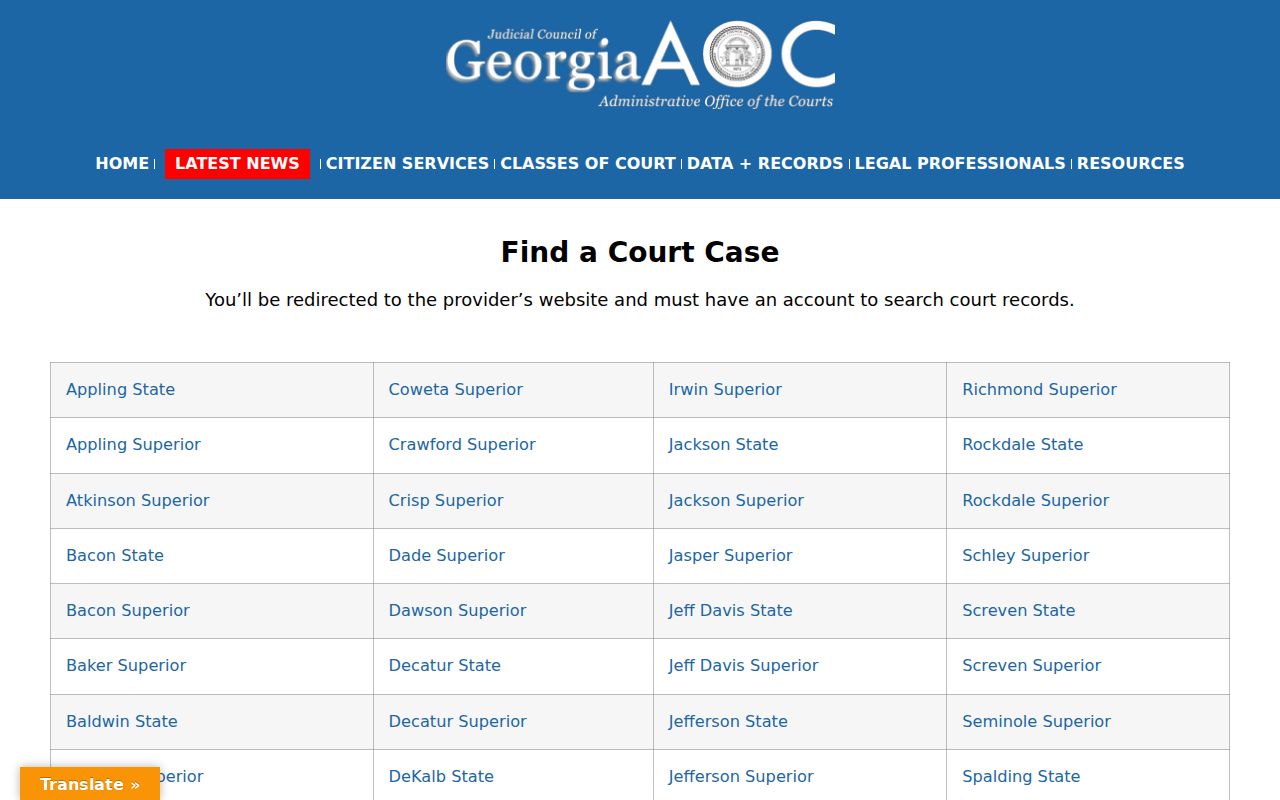
The directory confirms where online Baldwin Superior and State Court searching is routed, but live document visibility remains provider-dependent.
Online silence is not a disposition. Verify a Baldwin County criminal court case with the clerk before drawing a conclusion from an outage or empty result.
Inside a Baldwin County Case File
A Baldwin County criminal case file may contain a chronological docket and selected documents. The visible fields depend on the court and provider. Research could not inspect an authenticated, anonymized PeachCourt case, so the fields below describe the records to ask the live system or clerk to verify, not a promise that every item is downloadable online.
| Case number | The court's identifier for the prosecution. |
|---|---|
| Filing date and court | Shows when and where the case entered the docket. |
| Party and charge | Names the accused party and allegation as filed. |
| Status and events | Lists hearings, motions, calendar calls, and continuances. |
| Plea or verdict | Records the answer to the charge or trial result. |
| Disposition | Shows dismissal, no bill, nolle prosequi, acquittal, guilty result, or another outcome. |
| Sentence and costs | May state confinement, probation, fines, restitution, and court costs. |
| Documents | Availability varies by portal, age, sealing, and access rules. |
A charge line is an allegation until the disposition states what happened. The filed count can also differ from the charge written at booking because a prosecutor or grand jury may amend, reduce, dismiss, or replace it.
Reading Baldwin Case Dispositions
Georgia abbreviations can turn a short docket line into a puzzle. DISM means dismissed. NPGJ means not presented to the grand jury, while NFAA means no further action anticipated. A no bill means the grand jury declined the charge. Nolle prosequi means the prosecutor chose not to continue it. A dead docket is inactive, but it is not automatically erased.
- Accusation
- A Georgia charging instrument often used without an indictment.
- Indictment
- A grand jury's true bill that formally charges the listed offense.
- Nolo contendere
- A plea treated as a conviction for criminal-record interpretation.
- First Offender
- A Georgia deferred-adjudication framework whose successful discharge must be reported correctly.
- Disposition
- The outcome attached to each charge, not merely the overall case label.
If GCIC lacks a final outcome, obtain or confirm the Baldwin County certified disposition and ask the clerk how the court transmits a correction. Accuracy correction and record restriction are separate processes.
How a Criminal Case Moves
A Baldwin County case can begin with a warrant, arrest, complaint, or citation. The prosecutor then decides whether and how to file. Felony charges may proceed by grand-jury indictment, while other Georgia prosecutions may use an accusation. Arraignment supplies the formal plea, and discovery and motions shape what reaches negotiation or trial.
Case flow: Charges Filed → Arraignment → Pretrial → Plea or Trial → Disposition → Sentencing.
Later entries may include appeal, probation conditions, revocation proceedings, a bench warrant, record restriction, or a sealing order. Each stage can produce a new docket event without changing the final disposition. Read the latest order and the outcome for each charge, not just the first line in the file.
Certified Baldwin Court Records Online
For a certified court record, the Baldwin clerk links the Georgia Superior Court Clerks' Cooperative Authority ECertification service. It operates around the clock throughout the year and requires an account. Research did not locate a reliable general Baldwin copy-fee schedule, so users should ask the clerk or service for the current charge rather than import a rate from another county.
The Georgia ECertification login is the clerk's named electronic ordering route.
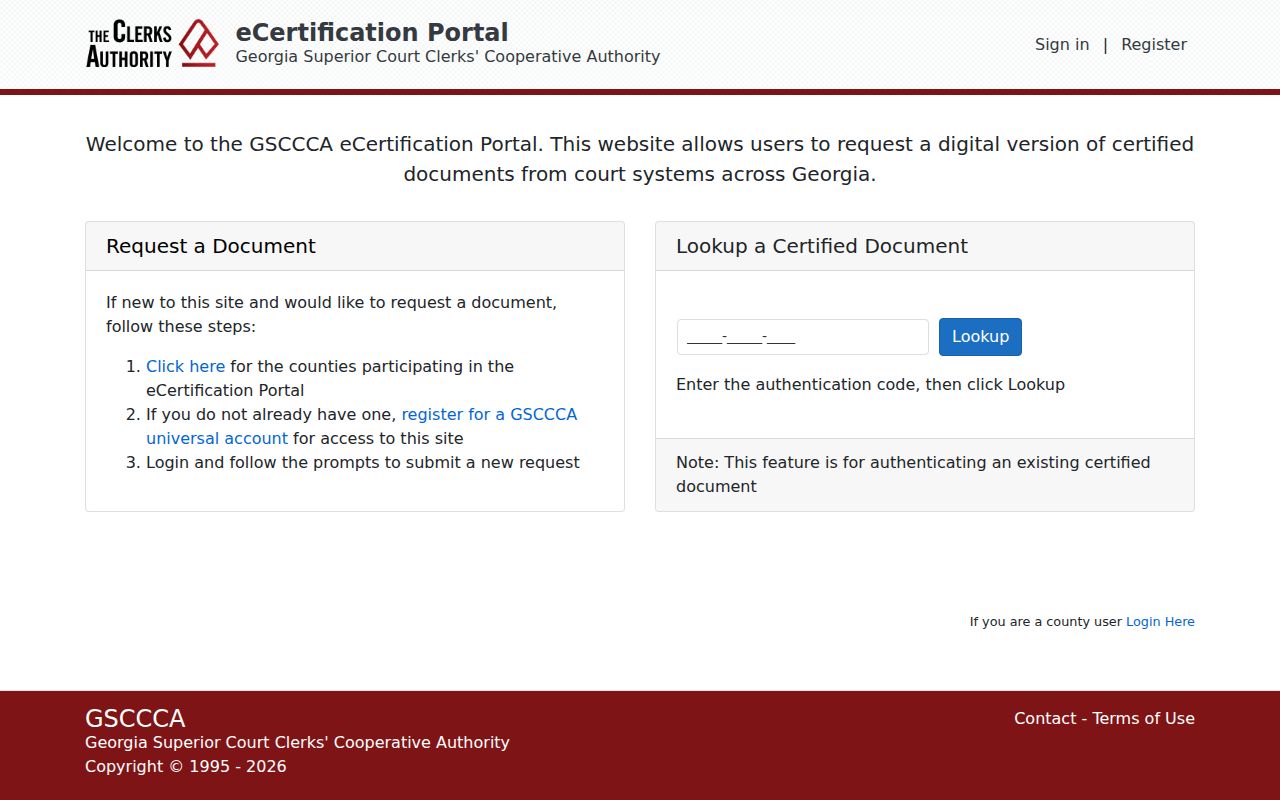
Certification can matter when the final disposition must be proved or used to correct an incomplete GCIC entry.
Note: Ask separately about a plain copy, certified disposition, full certified file, archive search, and any retrieval charge.
Milledgeville Court Is a Separate File
Milledgeville is Baldwin County's only incorporated city, and its Municipal Court maintains a distinct city-level record path. It handles ordinances, traffic citations, and authorized misdemeanors. The court's online payment gate is not a public case-search database. Paying a citation is an admission; a person who plans to contest it should follow the court's appearance instructions instead.
The Milledgeville Municipal Court page explains its jurisdiction, sessions, contact, and payment choices.
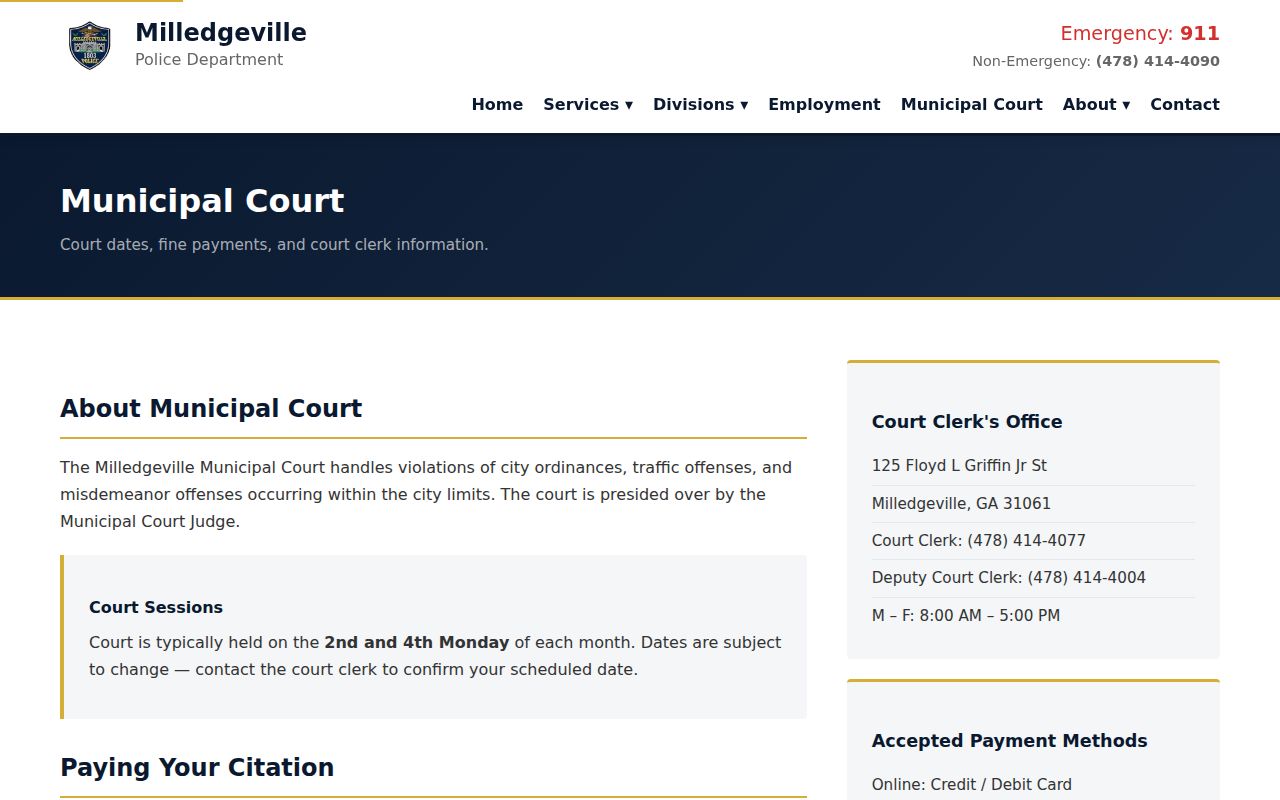
The city clerk phone and counter are the accurate fallback for case status and copies when the payment screen cannot answer a record question.
Failure to appear can add a fine, produce a bench warrant, or trigger a driver's-license suspension. Those consequences make it important to distinguish payment access from docket access and to verify the current court status directly.
Case Record Access and Restrictions
The Georgia Open Records Act, O.C.G.A. §§ 50-18-70 through 50-18-77, supports access to public agency records unless an exemption applies. Court access also reflects judicial rules and confidentiality protections. Juvenile matters, sealed records, protected personal data, and some active or sensitive documents may be withheld or redacted. Nonappearance online does not prove that a file never existed.
Georgia record restriction under O.C.G.A. § 35-3-37 limits qualifying charge information in ordinary GCIC dissemination but does not destroy it. A separate superior-court sealing order may be required to limit a local court index, calendar reference, or file. A person reviewing their own Baldwin County criminal court case should first correct any missing disposition, then evaluate restriction and sealing as distinct forms of relief.
When requesting a public file, describe the case narrowly and ask the custodian to cite the legal basis for any denial. Older files may require manual retrieval. Exact archive coverage and Baldwin general-copy fees were not published in the sources reviewed.